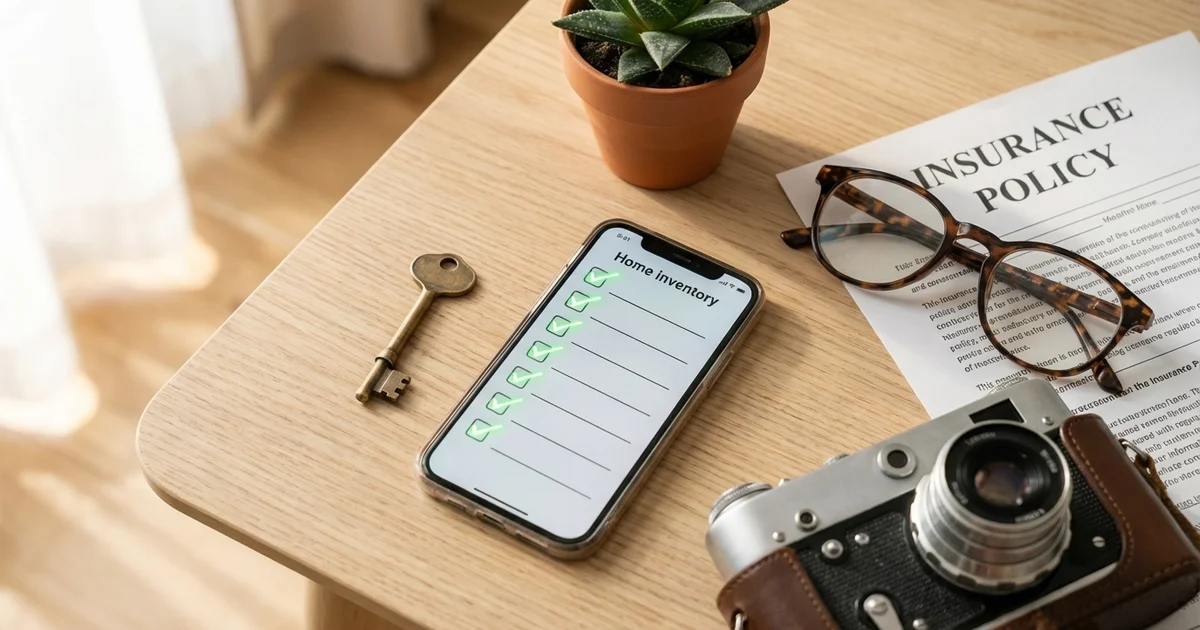
You know that moment of dread—disaster strikes and you're scrambling to figure out if your stuff is actually covered. Now you can track your policies right alongside your belongings in Squared Away.
You know that moment of dread. The basement floods. A pipe bursts. Someone breaks into your storage unit. And suddenly you're scrambling through drawers, searching your email, trying to figure out: Is any of this actually covered?
Most of us have insurance. Far fewer of us actually know what it covers.
That vintage guitar you inherited from your grandfather—is it on your policy? The camera equipment in your storage unit—does your homeowner's insurance even apply there? That engagement ring you keep meaning to get appraised—would you get its actual value if something happened?
These aren't hypothetical questions. They're the ones that keep people up at night after disaster strikes.
The Insurance Blind Spot
Here's the uncomfortable truth: most homeowner's and renter's policies have limits on specific categories of items. Jewelry often caps at $1,500. Electronics at $2,500. Collectibles might not be covered at all unless they're specifically listed.
That means the $5,000 camera sitting in your closet? Your policy might only pay out half its value. The coin collection worth $10,000? Possibly nothing.
And if you're storing things off-site—a storage unit, a relative's garage, your vacation home—the coverage question gets even murkier.
The problem isn't that people don't care about insurance. It's that the information lives in one place (a policy document you probably haven't read since you signed it) while your stuff lives in another (scattered across your home and storage spaces). There's no easy way to connect the two.
Until now.
Introducing Insurance Tracking in Squared Away
We built Squared Away to answer the question "where did I put that?" But our users kept asking us another question: "and is it covered?"
So we built something to answer that too.
Starting today, you can track your insurance policies directly in Squared Away and link them to your storage locations and items. It's not a replacement for your insurance company's app or your agent—it's the missing layer that connects your coverage to your actual belongings.
Here's what you can do:
See all your policies in one place. Homeowner's, renter's, storage unit coverage, scheduled property policies—add them all and see your complete coverage picture at a glance. No more digging through filing cabinets or email archives when you need to know what you have.
Link policies to locations. Your homeowner's policy covers your house. Your storage unit policy covers... your storage unit. Now you can make those connections explicit, so when you're looking at any location in Squared Away, you immediately know which policy applies.
Schedule high-value items. Got something worth more than your policy's category limits? You can mark items as "scheduled" on a specific policy and track the declared value. When you're looking at that vintage guitar or engagement ring in the app, you'll see exactly how it's covered.
Get expiration alerts. Policies expiring in the next 30 days show up with a warning, so you're never caught off-guard by a lapse in coverage.
Know your coverage gaps. See at a glance which locations don't have linked policies and which high-value items might need to be scheduled for full protection.
Why This Matters (A Story)
Last year, a friend of mine had a storage unit break-in. Tools, camping gear, some boxes of who-knows-what—all gone. When she filed a claim, she discovered three things:
- Her homeowner's policy only covered off-premises storage up to 10% of her total coverage
- Several items exceeded their category limits
- She couldn't remember half of what was actually in there
The claim process took months. The payout was a fraction of what she'd lost. And worst of all, she kept remembering things weeks later—oh, that's where my ski boots were—long after it was too late to add them to the claim.
If she'd had an inventory with photos and values, linked to her policy information, the whole experience would have been different. Not painless—insurance claims are never fun—but at least straightforward.
How It Works
If you're already using Squared Away, adding insurance tracking takes just a few minutes.
Step 1: Add your policies. Go to the new Insurance section (you'll find it in the More menu) and tap the + button. Enter your policy details: the provider, policy number, coverage limits, deductible, and expiration date. You can also add your agent's contact info for easy reference.
Step 2: Link to locations. When adding or editing a policy, you'll see all your Squared Away locations. Check the ones that policy covers. A homeowner's policy might cover your main house and detached garage. A separate policy might cover your storage unit.
Step 3: Schedule high-value items. When you view an item, you'll see a new Insurance tab. If the item's location is covered by a policy, you'll see that policy listed. For high-value items, you can tap "Schedule Item on Policy" to add it as a specifically covered item with its declared value.
That's it. Now when you look at any item, you'll know if it's covered. When you look at any location, you'll see which policies apply. And when a policy is about to expire, you'll get a heads-up before it lapses.
What We're Not
A quick note on what this feature isn't: we're not an insurance company, we're not providing insurance advice, and we're not replacing your relationship with your agent.
What we are is an organization tool that now includes a place to track your coverage alongside your belongings. Think of it like keeping your policy documents in the same filing cabinet as your home inventory—except this filing cabinet is searchable, always with you, and actually tells you when something's about to expire.
For specific questions about your coverage, deductibles, or whether you should schedule a particular item, talk to your insurance agent. They're the experts. We just make it easier to have informed conversations with them.
For the "What If" Moments
Nobody likes thinking about worst-case scenarios. But the peace of mind that comes from knowing you're covered—really knowing, not just assuming—is worth the few minutes it takes to set this up.
The next time you look at that inherited guitar, that camera collection, or that storage unit full of seasonal gear, you won't have to wonder. You'll know exactly which policy covers it, whether it's scheduled for its full value, and when that coverage expires.
And if something ever does go wrong, you'll have photos, values, and coverage information all in one place—ready to file a claim without the scramble.
Because the best time to figure out your insurance coverage isn't after disaster strikes. It's right now, while everything's fine and you have time to do it right.
Tags
Related Articles

Introducing Inventory Audits: Know What You Own, What It's Worth, and Where It Is
Your inventory drifts out of sync with reality over time. Inventory Audits gives you a structured way to verify what you own, confirm values, and track documentation.
How Natural Language Search Saves You Time
Discover how natural language search in Squared Away transforms finding your digital files from keyword guessing to simply asking questions in plain English.