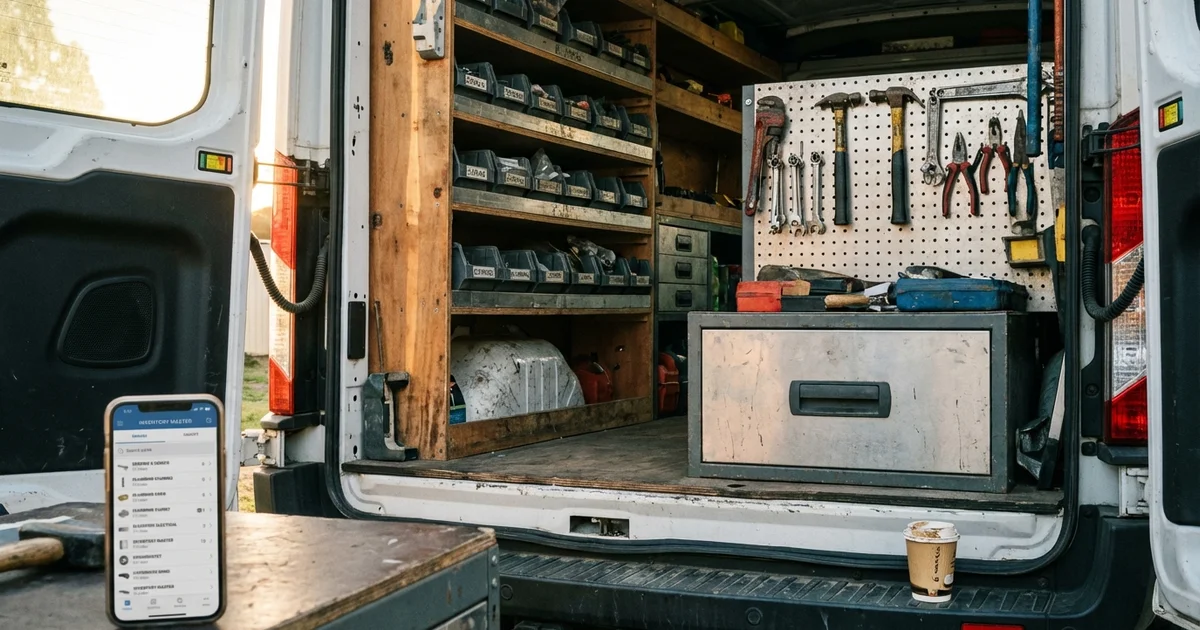
You're halfway through a job when you need a specific fitting. It's definitely in one of the bins. Twenty minutes later, you've torn apart three storage locations and you're running behind.
You're halfway through a job. The fitting you need is definitely in one of the bins on the van shelf. Or maybe it's in the garage. Actually, didn't you move some stuff to the shed last month?
Twenty minutes later, you've torn apart three storage locations, your knees hurt from crouching, and you're now running behind schedule. The fitting? It was in the first bin you checked—you just didn't dig deep enough.
Sound familiar?
If you're a tradie or serious DIYer, you've lived this moment dozens of times. Maybe hundreds. And every time, you tell yourself the same thing: "I really need to organize this stuff."
The Hidden Cost of Tool Chaos
Here's what most people don't calculate: the time spent searching for tools and materials isn't just frustrating—it's expensive.
A tradie who spends 15 minutes a day looking for things loses over 60 hours a year. That's more than a full work week, every year, just searching. For DIYers, weekend projects stretch into multi-weekend ordeals because half the time goes to hunting down that one specific drill bit or finding where you stored the leftover screws from the last job.
Then there's the duplicate problem. How many times have you bought something you already owned because you couldn't find it—or didn't even remember you had it? That third tape measure. The "backup" set of Allen keys. The wood stain you bought because you forgot about the half-full can behind the paint tins.
It adds up fast.
Why Traditional Organization Fails for Tools
Most organization advice doesn't work for people who actually use their tools regularly. Pegboards look great in magazine photos, but they don't help when your gear lives across your van, your garage, your workshop, and three different job sites.
Spreadsheets? You'll update them twice and never touch them again.
Taking photos? Great, except now you have 400 random tool photos in your camera roll with no way to search them.
The reality is that tradies and DIYers have a unique organizational challenge: your stuff moves. It's not sitting in a closet waiting to be found—it's in circulation. On the truck today, back in the garage tomorrow, lent to a mate next week.
A Different Approach
What if you could just ask "where's my 32mm socket?" and get an actual answer?
Not a folder to browse through. Not a spreadsheet to scroll. An actual location: "Van → Tool chest → Second drawer → Socket organizer."
That's what Squared Away does. It's an app that lets you photograph your tools and equipment, then uses AI to identify them and make everything searchable with plain English questions.
The key difference from other inventory apps: it mirrors how you actually store things. Your digital organization matches your physical organization—so finding something digitally means knowing exactly where to grab it physically.
How It Works for Tradies and DIYers
Setting Up Your Spaces
First, you create your storage locations. For a typical tradie, this might be:
- The Van — with shelving, toolboxes, and the chaos zone under the bench
- Home Garage — main workshop area, wall storage, and overflow shelving
- Shed — seasonal equipment and bulk materials
- Current Job Site — temporary location for active project gear
For a DIYer, it might be:
- Garage Workshop — primary work area and tool storage
- Garden Shed — outdoor tools and lawn equipment
- Under-Stairs Cupboard — overflow and project materials
- Attic — seasonal and rarely-used items
Each space can have sub-locations that match your actual setup: shelves, drawers, bins, toolboxes, wall hooks—whatever you've got.
Adding Your Gear
Here's where the AI earns its keep.
Snap a photo of a tool. The app identifies it, suggests a name, assigns a category, and adds relevant tags—automatically. A photo of your Makita impact driver doesn't just become "power tool." It becomes "Makita 18V Impact Driver" filed under "Power Tools" with tags like "cordless," "drilling," and "fastening."
You can add details if you want—purchase date, warranty info, serial number—but you don't have to. The basics happen automatically.
For tradies with a van full of gear, the fastest approach is working through one storage area at a time. Open a drawer, photograph everything in it, assign them all to that drawer's location, done. Most people get their primary tools catalogued in an evening.
Finding What You Need
This is the payoff.
Standing at a job site, you need a specific fitting. Instead of calling home or driving back to check, you pull out your phone: "where's the 15mm compression elbow?"
The app shows you: it's in the van, top shelf, in the clear bin labeled "brass fittings." Or it tells you it's actually at home in the garage, which saves you 20 minutes of searching through the van.
The search understands how people actually talk. "Christmas lights" finds items tagged as "holiday decorations." "Screwdriver for tiny screws" finds your precision screwdriver set. You don't need to remember exact names—just describe what you're looking for.
Tracking What's Where
Here's something tradies especially appreciate: the checkout system.
When you lend your tile cutter to another tradie, mark it as checked out. Now you know it's not missing—it's with Dave. When Dave returns it (eventually), check it back in.
Same goes for tools at job sites. Mark items as being at "Current Job - Kitchen Reno" and you'll know exactly what's there versus what's back at the workshop. When the job wraps, you've got a checklist of everything that should be coming home.
Real Scenarios
The Sparkie's Van
Matt's an electrician. His van has evolved over 12 years into a complex ecosystem of bins, cases, and "organized chaos." He knows roughly where things are—until he doesn't.
After photographing his van setup over a weekend, he can now:
- Check if he has a specific connector before driving to the wholesaler
- Find rarely-used specialty tools without emptying half the van
- Keep track of what's at client sites versus what's on the van
- Stop buying duplicate cable ties, tape, and fittings
The biggest win? When his apprentice asks "where's the [specific thing]," Matt can just say "check the app" instead of explaining the van's organizational logic for the hundredth time.
The Weekend Warrior's Garage
Sarah tackles a couple of home projects every month. Her garage has accumulated tools and materials over years of projects—some organized, some... less so.
Her setup includes:
- Hand tools on a pegboard wall (photographed by section)
- Power tools on a dedicated shelf
- Project materials in labeled bins
- "Random useful stuff" in the drawer unit
When starting a new project, she searches for relevant materials: "sandpaper," "wood screws," "stain." The app shows her what she already has, where it is, and whether she needs to buy more—before she's standing in the hardware store aisle wondering if she already owns this.
The Multi-Location Contractor
James runs a small building crew. Tools and equipment constantly move between his workshop, two vans, and active job sites. Before Squared Away, tracking gear meant a lot of phone calls and guesswork.
Now each major tool shows its current location. The compound mitre saw is at Site A. The nail guns are split between both vans. The scaffolding sections are at the workshop waiting for the next job.
When quoting a new job, James can quickly check if the needed equipment is available or tied up elsewhere. When wrapping a job, there's a clear list of what should be coming back.
Getting Started Without Losing Your Weekend
The prospect of cataloguing years of accumulated tools feels overwhelming. Here's how to make it manageable:
Start with what frustrates you most. That one toolbox where you can never find anything? Start there. Getting one problem area sorted shows you how the system works and provides immediate benefit.
Do high-value items first. Your power tools, specialty equipment, and expensive gear. These are the things that hurt most to lose or replace, and they're usually already somewhat organized.
Build as you go. Every time you touch a tool that's not in the system, take 30 seconds to photograph it. Over a few weeks, your inventory builds naturally through regular use.
Don't aim for perfect. A rough catalog of 80% of your stuff, with approximate locations, is infinitely more useful than a perfectly detailed spreadsheet you'll never finish.
The Stuff Nobody Talks About
Beyond finding tools faster, there are some less obvious benefits:
Insurance documentation. If your van gets broken into or your garage floods, you've got photographic proof of everything you owned. Model numbers, conditions, the lot.
Knowing when to let go. Seeing everything you own in one place makes it easier to spot redundancy. Three nearly-identical circular saws? Maybe two can go.
Lending with confidence. When you lend something out, you've got a record. No more "I'm pretty sure I lent that to someone" uncertainty.
Project planning. Starting a new job? Search for everything you'll need and see exactly where it all is before you start loading the van.
The Real Measure
Here's the honest truth: no app will make you organized. Organization is a habit, and tools—digital or otherwise—only work if you use them.
But the right tool makes the habit easier to maintain. When adding an item takes 30 seconds instead of filling out a spreadsheet, you actually do it. When finding something means typing a question instead of rummaging through bins, the payoff is immediate.
The measure of success isn't having a perfect digital inventory. It's spending less time looking for things and more time using them.
That socket set is somewhere. Now you can actually find it.